
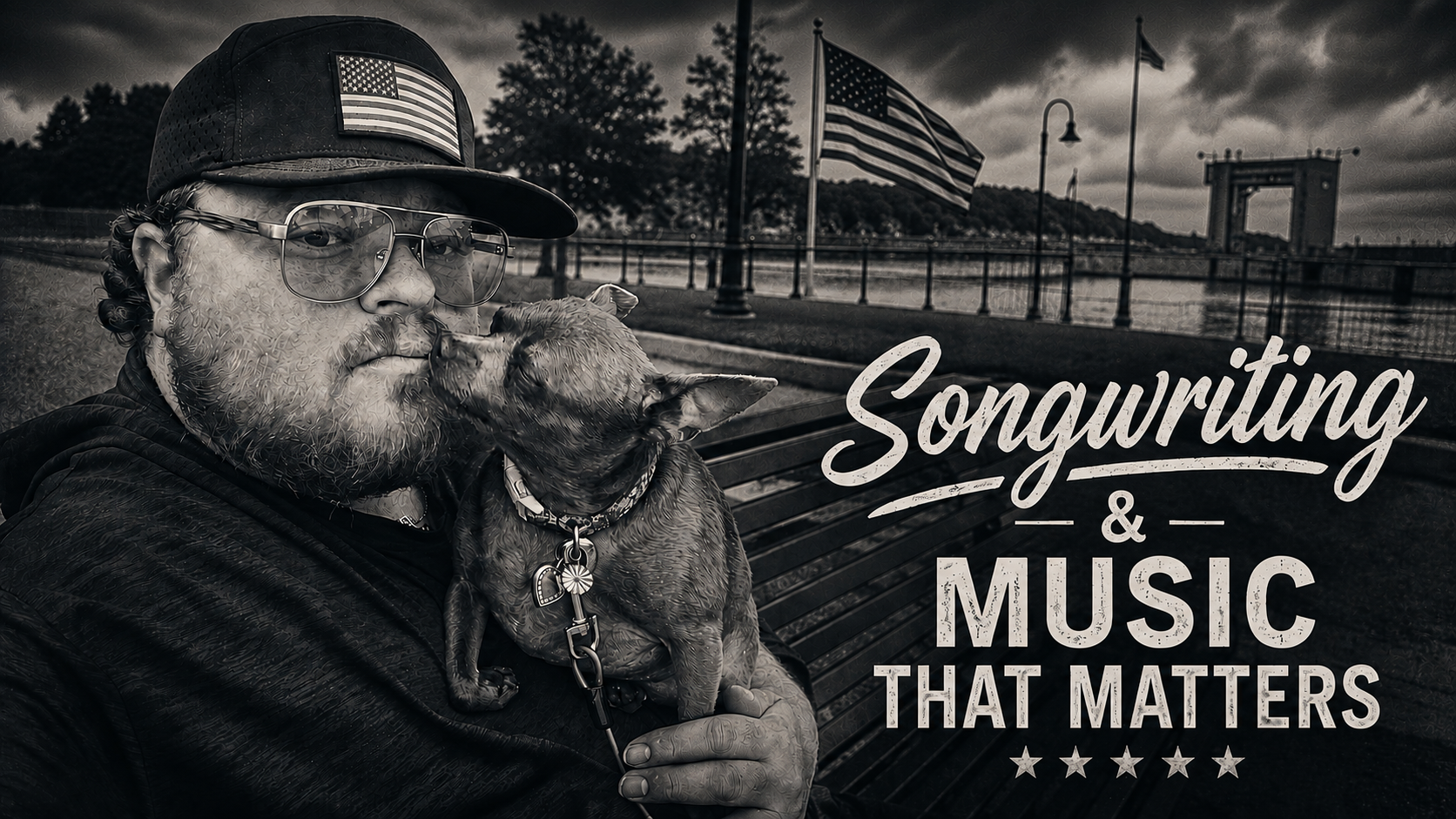
From The Bedroom to the Open Road, a Port Huron Songwriter Turns Faith, Family and Freedom Into Music That Matters
From the banks of the St. Clair River to communities across America, Michael Scott is building an independent music career centered on faith, hometown pride and the belief that everyday people deserve to have their stories heard.
Based in Port Huron, Michigan, Scott is an Americana and country-rock songwriter, vocalist and digital music producer. His music combines traditional country, acoustic Americana, heartland rock and blues-influenced storytelling, accented by occasional elements of hip-hop through rhythmic delivery, modern production and direct social commentary.
His catalog consistently returns to three principles—faith, family and freedom—along with themes of resilience, redemption and everyday life in working-class America.
The message is resonating. Since beginning his musical mission in March 2026, Scott’s catalog has surpassed 38,000 streams. He has attracted more than 1,700 monthly listeners on Spotify, while his Facebook following has grown to over 1,600 people.
For Scott, however, the numbers matter because each one represents a person who might need the same hope music once gave him.
“I started writing and producing again because it gave me hope and helped lift me out of a very dark place. At first, the music was helping me heal, but I quickly realized it was also affecting the people I shared it with. From there, God put it on my heart to pursue music as a way to help others.”
That realization transformed a creative outlet into a personal mission.
“It means the world to me because one listener can represent one person helped—or even one life saved. A few years ago, my struggles and decisions brought me to a place where I considered taking my own life. But God stepped in. I believe He knew a time would come when I could use what I survived to serve a greater purpose.”
From Port Huron to American Crossroads
Port Huron is more than a location in Scott’s biography. The city and Michigan’s Blue Water region are fundamental parts of his identity.
Scott traces his values to the people who raised him and to a community shaped by work, perseverance, loyalty and faith.
“I come from a long line of hardworking blue-collar and white-collar people—lovers, fighters and believers. I’m proud to be from Port Huron. Those early days and the people who shared them with me helped shape me into the person I am today.”
That connection is especially evident in “Little Town I Love,” his hometown tribute built around personal memories, familiar places and the lasting pull of home.
Scott approaches songwriting visually, attempting to create scenes that listeners can enter rather than simply describing a location from a distance. The song’s collage-style video expands that portrait by highlighting Port Huron’s businesses, landmarks and local character.
“I take a cinematic approach to all my music and try to paint a portrait for the listener. With ‘Little Town I Love,’ I wanted people to see Port Huron’s identity and beauty while experiencing the places and moments that brought me so much joy growing up. I’ve been to a lot of places, but there’s nowhere quite like Port Huron.”
Scott expanded that hometown perspective with his debut album, American Crossroads (Signature Edition). Released independently in April 2026, the project established many of the subjects that continue shaping his songwriting: spiritual conflict, personal responsibility, American identity, family relationships and the search for hope during difficult seasons.
Rather than separating faith from real life, Scott places belief inside stories about addiction, hardship, families, communities, redemption and second chances.
A Michigan Kind of Country
Scott’s music is grounded in country and Americana without being confined to one traditional format.
Heartland rock gives certain songs their drive, while blues adds weight to his more reflective material. Hip-hop occasionally appears in the rhythmic phrasing, percussion and directness of his writing, but it remains an influence rather than the foundation of his sound.
That creative freedom is essential to what Scott calls a “Michigan Kind of Country.”
“There are no rules with a Michigan Kind of Country. You can blend genres and push boundaries while still maintaining a core musical identity. I grew up with a wide range of influences passed down by the people closest to me, and you can hear those influences throughout my writing and music.”
Scott’s listening history reflects that range. His favorites include the Goo Goo Dolls, old Kid Rock music, Eminem, Tupac Shakur and The Notorious B.I.G., alongside classic, arena and Southern rock from the 1960s through the 1980s.
His friend Rusty Fournier introduced him to blues, Motown and country artists ranging from Johnny Cash to Jelly Roll, Luke Bryan, Cole Swindell, Jason Aldean, Florida Georgia Line and Tim McGraw.
“If I could get my hands on it, I listened to it. Music has always been a major part of my life.”
As he develops into a live performer, Scott also looks to local and regional artists for inspiration. Among those influences are Julianne Ankley, Glenbrooke & The Wild Weeds, the Gasoline Gypsies, Ryan Scott & The Creek Hounds, Denny Dwyer, Paul Harris, Dirty Dan & The Tattooed Souls, their extended family of musicians known as the Dirty Dozen, and Stacey Lee.
“They are incredible musicians and songwriters whose talent inspires me every time I pick up a guitar or work on my vocals.”
Scott followed American Crossroads with Campfire Chords, a nine-song acoustic collection released July 1, 2026. Featuring songs such as “Days Go By,” “Wings Spread Wide,” “Somethin’ In Between,” “Dead Man Walkin’,” “Bad Decisions” and “Daisee Mae,” the project places greater emphasis on lyrics, chord progressions and personal storytelling.
Working independently through his imprint United Faith Music Group, Scott continues overseeing his songwriting, production, visual identity and public message through a grassroots approach.
Radio-Friendly Releases and Deeper Social Commentary
Among Scott’s latest releases are the more radio-friendly “Vincent Road” and “Sunny Daze (Livin’ Free),” both of which continue gaining traction with listeners. Their memorable hooks and inviting country sound provide an accessible introduction to his catalog.
“Vincent Road” is rooted in Scott’s childhood memories and the rural St. Clair County roads he still travels when life becomes overwhelming.
“Whenever life gets tough, I drive. I head out into the country, get lost in the back roads and find peace listening to music while taking in the beauty of God’s country. It’s my reset.”
The route described in the song is real, as is the emotional connection behind it.
“‘Vincent Road’ brings back some of my best early-childhood memories, and that rural foundation has stayed with me throughout my life. I still drive the route depicted in the song, along with other roads throughout St. Clair County, to reconnect with those places and remember the good times.”
While those releases show Scott’s more radio-friendly side, songs such as “American Dream” and “Unity” reveal some of his strongest social commentary.
The tracks examine political and social division, the consequences of precedent-setting decisions by politicians and lawmakers, and how the loss of established rights and freedoms can affect citizens in their daily lives.
Scott approaches those subjects through the perspective of ordinary Americans rather than through loyalty to a political party.
“United, we are strong; divided, we are weak. Our veterans and service members did not sacrifice so my generation—or those after us—could simply roll over and give up. I want to inspire young leaders to stop talking about change and start creating it through unity, respect for different beliefs and honest, productive conversation.”
He believes Americans must learn to disagree without viewing one another as enemies.
“We live in a free nation under God, and part of that freedom is accepting that we will not always agree. Respect my choices, and I will respect yours. The time to act is now—but we must do it with grace, peace, love and prayer.”
His songs ask listeners to consider what still unites the country, what is at risk and what kind of nation today’s decisions may leave for future generations.
Sharing the Journey in Real Time
Scott is not waiting until he reaches a polished or predetermined destination to tell his story. He is sharing the journey with listeners and followers as it happens—including its victories, mistakes, setbacks, travel challenges and unfinished stages.
His audience can watch his musical development in real time as he learns acoustic guitar, strengthens his voice, practices with backing tracks and prepares to bring his original music to a live stage.
Scott began singing before learning guitar. He now practices combining both skills publicly on streets, park benches and beaches, as well as at open mics. By documenting that progress, he hopes to show others that they do not need to be completely prepared before beginning something meaningful.
“People need hope now. I’m just another guy who decided to write and sing some songs and put a guitar in his hands. If sharing the mistakes and unfinished parts of my development helps someone believe they can begin too, then it is worth showing.”
His Uncle Chris and Aunt Kim Flynn played an important role in turning that interest into a serious pursuit. After hearing several demos, they encouraged Scott to consider professional songwriting.
“They heard a few of my demos, believed there was something there and pushed me to take it seriously. My uncle told me that my time is now—and that our time as a country is now. The rest is history.”
Scott is candid that he is still developing and does not yet consider himself fully ready for the stage. At the same time, he believes that goal is closer than many people realize.
“Like everything worthwhile, it takes hard work. But with passion, consistency, the Lord’s favor and support from family and friends, you really can achieve almost anything.”
He continues learning from experienced performers while accepting that public growth will inevitably include uncomfortable moments.
“I’m not afraid to bare my soul or occasionally embarrass myself because I have a vision and clear goals. Everyone starts somewhere. Stumbling and falling are part of growing; the key is learning from those failures, finding the value in them and proactively moving forward. People are watching and listening. Some are in my corner, and others are quietly waiting for me to fail. Those doubters are the fuel that ignites my fire to get better at something each day.”
From Rock Bottom to a Life on the Road
Scott has traded the familiarity of his hometown for a life on the road with his Chihuahua, Daisee Mae.
The decision reflects both his adventurous nature and the financial circumstances he faced as housing costs and broader economic pressures created an uncertain future.
“I’ve always been a rolling stone. The road is where I feel most comfortable because I long for adventure, new experiences and the unknown. On a more personal level, my financial circumstances and the realities of today’s housing market forced me to confront the possibility that I could end up on the streets myself. But God blessed me with a car.”
Scott’s needs are intentionally simple.
“All I need in this crazy world is a pen and paper, my guitar, my music, my pup, four wheels and my Bible. That is home for me now.”
At certain stops, family members and friends have offered him shelter, companionship and a place to recover. During other stretches of travel, he sleeps at truck stops and rest areas.
The journey has taken Scott and Daisee Mae from Port Huron to Sault Ste. Marie in Michigan’s Upper Peninsula, followed by stops in Roscommon and Hastings, Michigan; South Bend, Indiana; Springfield and Rochester, Illinois; a brief late-night drive through Nashville; Cosby, Tennessee; and Steele Creek, North Carolina, near Charlotte.
Future plans are expected to take them through Texas, Colorado and California.
Scott describes the road as a chosen calling, drawing inspiration from Isaiah 6:8:
“This is a life and a path I have chosen. ‘Here am I. Send me.’ That is my prayer: ‘Lord, please send me.’”
Daisee Mae is more than a traveling companion. Her loyalty and presence have made her the face of Scott’s movement and one of the most important parts of his personal story.
“On a deeply personal level, Daisee Mae saved my life. Before her, my life felt like a tragedy. She gave me purpose. Her loyalty, friendship and love have never wavered, and I believe God placed her in my life when I needed those things most.”
Scott is equally clear about the importance of the relatives and friends who stood beside him.
“My family and friends have been equally important. Without Daisee Mae and the people who supported me, I believe I could have become another statistic—another casualty of the struggles affecting so many people in our society.”
Making a Difference Beyond the Music
Scott’s purpose on the road extends beyond developing as a performer or promoting his catalog.
When opportunities arise, he feeds people experiencing homelessness and assists those living in poverty. A stop in South Bend became a turning point after he witnessed how many people were living without secure housing.
“When I reached South Bend, Indiana, I saw how many people were living on the streets, and it broke my heart. That was the moment I decided I could—and should—do more.”
Scott encourages others to look beyond stereotypes and recognize the dignity of the person in front of them.
“I encourage people to put judgment aside and recognize the human being in front of them. In this day and age, no one should have to wonder where their next meal will come from or where they can safely lay their head at night.”
Scott has also launched a T-shirt line to help cover travel expenses, vehicle repairs and the costs of sustaining his independent musical mission.
He has pledged half of its net proceeds to faith-based organizations, veteran and military charities, and foundations supporting physical, mental and social health. The remaining proceeds help fund transportation, lodging, repairs, equipment and continued music creation.
“This isn’t about money or fame for me. It’s about making a difference. I’ve already described the simple things I need to be happy; everything else is a bonus, and most of it is for the birds. When I die, money and recognition won’t mean a damn thing.”
The commitment reflects Scott’s belief that his work should ultimately be measured by how it serves others.
“I’m trying to do what I can to help my brothers and sisters here on Earth while working toward Heaven myself. When I reach those gates, I’m sure the Lord will have plenty of questions for me. I just hope He understands that I’m doing my best every day to live a life worthy of His vision.”
Turning Personal Battles Into Purpose
Scott has spoken openly about the experiences that shaped his life, including anxiety and depression, substance abuse, severe weight gain and fluctuation, financial hardship, legal trouble during his youth and other social challenges.
He does not present himself as someone who has lived a perfect life. His message carries weight because it comes from someone who understands failure, isolation and the difficult process of rebuilding.
“None of those struggles are difficult for me to discuss. Living through them was hard; sharing them is easy. They are part of my truth, and I’m not ashamed of that truth.”
Instead of viewing those chapters only as sources of regret, Scott considers them part of what prepared him to communicate honestly with people experiencing similar struggles.
“Those experiences gave me a voice and a purpose. Looking back, I can recognize them as gifts—blessings that arrived in disguise.”
His advice to people who believe their past has eliminated their chance to build a meaningful future is direct.
“They are wrong. Lean on God, seek proper medical help and start living again instead of allowing yourself to waste away. You can receive all the support in the world, but until you look in the mirror, own your bullshit and decide to change, your life will remain the same.”
That message reflects a lesson passed down by his parents: hardship can slow a person down without permanently stopping them.
“My mom and dad taught me that sometimes you have to pick yourself back up, dust yourself off and hold your head high. Treat the hardships in your life as speed bumps rather than roadblocks, and you can keep moving forward.”
Music With a Purpose
Michael Scott’s story remains a work in progress—and that is exactly what he wants his audience to witness.
His catalog is growing, his audience is expanding and his transformation from songwriter and studio creator into a live performer is unfolding publicly. Every new song, lesson, performance attempt, personal conversation and stop along the road becomes part of a broader mission built around transformation and service.
Scott hopes his legacy will not be defined by streaming totals, follower counts or fame. He wants people to remember that he had the courage to begin and that starting over does not come with an age limit.
“I hope people remember that I wasn’t afraid—and that you are never too old to begin again. We’re living in a world where it is easy to become trapped in the algorithm, but the first day of the rest of your life can begin at any moment—with one prayer, one heartbeat, one step, one smile, one hug, one moment or one action.”
For Scott, success means transforming personal battles into songs, songs into conversations and those conversations into hope and meaningful action. His journey carries a direct message: someone can come back from rock bottom, reclaim ownership of their life and help others believe they can do the same.
Ultimately, everything returns to the three principles at the center of his music and mission:
“Faith, family and freedom—it’s all we have, and it’s all we know. Don’t take your life for granted. You get one shot. Do it right.”
Message from Michael Scott: Thank you for reading, listening, and sharing the content I provide daily. If you support faith, family, and freedom, please consider supporting this mission I've chosen to affect positive change in the lives of others here in America. You're support makes a difference and helps Music That Matters continue moving forward.